
What is an implantable RFID device?
Implantable Radio Frequency Identification (RFID) devices are small, ‘rice grain sized’ microchips, that are inserted much like an injection, using a syringe that places the chip under the skin. The implant consists of a glass case that is used to protect the RFID tag from bodily fluid once inserted, and only costs approximately $120 for a doctor to insert the implant. (ChipMyLife 2018)f
The device comes with a unique 16-character identification code and can be programmed as a pass to gain access to a number of services, devices and machines we use throughout everyday life. Functioning identically to how a membership card or FOB tag works, the chip does not rely on a battery to function, but rather, can be ‘read’ when waved over a scanner to verify the user.
This emerging technology has already been implanted into an estimated 30 000 – 50 000 clients globally, and due to its customisable characteristic, has the potential to be integrated into the gaming, medical, transport industries, and many more. Users have the capability to ‘tap on, and off’ with their local transport system using their hand, unlock smart locks to their house, paypass to purchase shopping and even to turn on their cars.
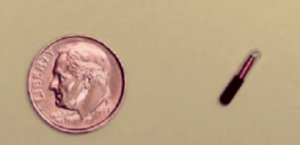
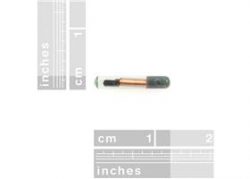
(RobotGear, 2018) g
HISTORY AND TECHNICAL
As Michael et al. ‘s 2008 ‘Microchip implants for humans as unique identifiers’ case study highlights “Microchip implants are not new” b, although coupling implants with RFID / NFC functionality is a new concept.
The origins of implantable chips come from the science and medical field in the exploration of the Pacemaker, where an idea of the device that could be inserted to jumpstart the heart began in 1958 from Doctor Albert Hyman. (Ward et al 2013) a
The history of Radio Frequency Identification (RFID) dates back to the 1920’s when it was first being explored in the US for basic Military uses such as radar and audio broadcasting technology. (Want 2006)c
Throughout the 20th century, RFID was refined and researched until the technologies potential was recognised for a large number of uses, beginning in the 1960’s when companies such as “Knogo, developed electronic article surveillance(EAS) equipment to counter the theft of merchandise”. (Landt 2005)d Albeit, it wasn’t until the development of Personal Computers (PCs) in the 1980s, that RFIDs “allowed convenient and economical collection and management of data from RFID systems.” (Landt 2005)d Up until then, RFID technology was predominately exercised in toll road gateways.
RFID implant transponders consist of an antenna that receives the radio signal, an integrated circuit (IC) which provides memory to store data (such as the unique identifier code) and a substrate or circuit board, acting as a catalyst to bind the two components together. (RFID Journal 2005)e
Users wave the implant over an RFID reader, which receives the signal via the antenna; this prompts it to reflect the data from the integrated circuit, back to the reader. From here the “reader passes the information to a computer, so that the data can be used to create a business value.” (RFID Journal 2005)e
IMPACT
RFID implants have an influence on society, business and healthcare industries, it’s implementation in transport, security, payments, authentication and accessibility directly affect users, as well as providers in the demand for compatibility rising; albeit has the potential to affect an even broader range of industries, extending into new computing tech, where Elon Musk discusses the potential of pairing implantable microchips with neuroscience technology into an individual’s brain, the result, enabling them to access and control other technology around them. Proving to be disruptive, and possibly even “hail the end of VR hardware” (Laura Cox 2016) h
In the paper by Rotter et al (2008) i, the Identification and Authentication benefits are discussed; as it highlights the characteristics of it being more convenient, and that “The user is not required to take any action; there is no need to type or confirm any information or to carry any token.” Furthermore, the article discusses that verification is “practically immediate” and has higher reliability trait, in contrast to other biometric authentication methods, “which due to the statistical nature of their matching process do not guarantee 100% error-free results.” Rotter et al (2008) i
The article then continues to emphasise the reliability benefits of the implant being “more durable than tokens and many types of biometrics, which usually change during a person’s lifetime.” (Rotter et al 2008) i
The characteristics of customisability, compatibility and effortlessness in RFID implants, proves disruptive to any industry that requires an individual to verify their identity; the foremost issue of this technology now, is ensuring the protection of personal information.
REFERENCES
a). Ward, C, Henderson, S and Metcalfe, N 2013, ‘A short history on pacemakers’, vol 169, no.4, pp. 244-248, retrieved 15 April 2018, https://www-sciencedirect-com.ezproxy-b.deakin.edu.au/science/article/pii/S0167527313016768?_rdoc=1&_fmt=high&_origin=gateway&_docanchor=&md5=b8429449ccfc9c30159a5f9aeaa92ffb&ccp=y
b). Michael, K, Michael, M and Ip, R, 2008, ‘Microchip implants for humans as unique identifiers: a case study on VeriChip’, retrieved 18 April 2018, < http://ro.uow.edu.au/cgi/viewcontent.cgi?article=1594&context=infopapers>
c). Want, R, 2006, ‘An introduction to RFID technology’, IEEE Pervasive Computing, vol. 5, no. 1, pp. 25-33, DOI: 10.1109/MPRV.2006.2
d). Landt, J, 2005, ‘The history of RFID’, IEEE Potentials, vol. 24, no. 4, pp. 8-11, DOI: 10.1109/MP.2005.1549751
e). Violino, B, 2005, ‘The Basics of RFID Technology’, RFID Journal, retrieved 20 April 2018 < http://www.rfidjournal.com/articles/view?1337/1 >
f). Chip My Life 2018, Implanting Services, retrieved 21 April 2018 < https://chipmylife.io/collections/implants/products/microchip-implanting-services-at-future-faqtory-9-nov >
g). Robotgear 2018, ‘RFID Glass Capsule’, retrieved April 21 2018 < https://www.robotgear.com.au/Product.aspx/Details/1510-RFID-Glass-Capsule-125kHz?gclid=CjwKCAjwzoDXBRBbEiwAGZRIeDvhGWJfhrUWAInLE_DNGDUI1tLLHxJd5BhgEKCx7ucDL7GYkveIqBoC_08QAvD_BwE >
h). Cox Laura, 2016, ‘VR in the Brain Disrupts VR Hardware’, Disruption, 20th October, retrieved 21 April 2018, < https://disruptionhub.com/disruption-disruption-vr-brain-disrupting-vr-hardware/ >
i). Rotter, P, Daskala, B and Compano, R, 2008, ‘RFID implants: Opportunities and and challenges for identifying people’, IEEE Technology and Society Magazine, vol. 27, no. 2, DOI: 10.1109/MTS.2008.924862